




'Hidden Safety' as concept
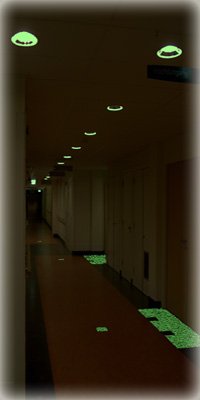 |
'Hidden Safety'© refers to an additional escape route signage, which remains unobtrusive at ordinary light conditions, but becomes clearly visible in the dark.
Extra
signage in the dark provides step by step reassurance along the route
towards (emergency)exits. As such they may enhance evacuation while mitigating
panic. Under (day)light conditions, however, extra signage is less required;
they may upset interior design (e.g. hotels) and may
even become a source of confusion particularly in environments abundant
in mismatched route indicators (e.g. hospitals, airports,
(railway)stations). On the contrary Hidden Safety signs blend
well with interior decoration.
The Institute for Human Factors of the Netherland Organisation for Applied Scientific Research (TNO) supports the introduction of additional indicators along an escape route to continuously reaffirm the desired path. As such such indicators enhance the effectiveness of commonly prescribed but sparingly installed pictogrammes above emergency exits. This holds especially true in public builings (e.g. shopping malls, parkings), where visitors are often unaware of emergency exits. Moreover, such exits are hardly noticed at greater distances, as common in large builings (e.g. theaters, congres halls) with complex hallways (e.g. offices, subway stations), while the route towards exits may be obstructed by mis-placed furniture (e.g. musea, labs) or shelves (e.g. warehouses). Additional signage structurizes the desired way out, thus preserving calmness during evacuations, as particularly required at schools or nursing homes.
Hidden Safety can be integrated in top light systems as well as various floor systems

More information can be viewed selecting the following links:
- powerpoint/slides (browser version)
- powerpointpresentatie (download (6 MB) / Powerpoint application required !)